

Welcome back readers.
It’s been a minute since I mentioned our Patreon, but it’s always timely to reiterate that your support powers this curatorial project, and is what has kept it going for a decade and a half already. We look forward to capturing a weekly snapshot of timely and interesting games crit for many years to come.
This Week in Videogame Blogging is a roundup highlighting the most important critical writing on games from the past seven days.
Media Mix
This week we’re starting with pieces that explore intersections between games and other media, with subjects ranging from anime, to ARGs, to concerts.
- How Dragon Ball Reruns in 90s Latin America Led To One of 2025’s Best Anime RPGs | Exalclaw
Wallace Truesdale talks to the devs of playable anime Wander Stars about gay Dragonball, the centrality of anime in Latin American media cultures, and more. - The King in Yellow as Found Footage Minecraft ARG | ARGNet
Michael Andersen pieces together a tale of a Minecraft server, recursive, unreliable narration, and cosmic horror (Further Reading: wadapan on Minecraft parkour machinima, Homestuck, and emergent narrative forms for new generations). - Low Roar | The White Pube
Gabrielle de la Puente muses on Death Stranding, its soundtrack, and art that lives on after the artist (Further Reading: Gabrielle’s previous writing on the series).
“All those quiet songs I knew, soft like the inside of a cheek, were arranged across 80 instruments and now his voice came to us atop a castle. Pauses in the music were filled with new movements, directions. The songs were stretched around a bigger architecture. There were pillars and pathways and waterfalls so that each song had so much more space. Became a whole city. I don’t know how else to put it except to say: it’s like, if the music from him, and him alone, was someone making a promise, on stage with the backing of an orchestra, he was telling the truth.”
Berlinterpellation
It’s a good week here for the genre sickos as we delve deeply into formal approaches, their stress tests, and their limits.
- what sort of game is an RPG? part 1: Suits and friends
bryn invokes TTRPGs as a focal point to unpack efforts to formalize the definition of a game over the years. - The São Paulo Interpretation of Immersive Sims | Azhdarchid
Bruno Dias clarifies and then complicates the imsim as a genre (Further Reading: Aura Triolo on imsims and interest).
“My overarching point here is not to argue for the futility of definition, or to try and place any games (besides the canon at the start of this article) exactly in or out of the immersive sim genre. It is, rather, to point out that there are so few truly unambiguous immersive sims that the immersive sim genre does not really fulfill the typical role of genres in games culture. That is, it is not a marketing label you can use to readily find more similar games like the one that you liked; if we imagine the corpus of available video games as one gigantic store, the shelf labeled “Immersive Sims” barely exists.”
Industry Arc
Next up, here’s an admittedly loose coalition of industry-adjectent topics, including the state of “indie”, LLMs/machine learning, achievements, and more.
- The future of indie games
v buckenham meditates on the increasing untenability of indie as a label for an ever-broadening and specializing metacommunity of game development (Further Reading: phantom on Cave Story). - Animal Crossing lost a bit of its soul when it turned the player into a god | AV Club
Catherine Masters laments the gradual deemphasis on community and communication as Animal Crossing morphs into an endlessly customizable forever platform. - A Really Late Redfall Theory | Ferg’s Frickhouse
Ferg crunches some numbers to offer a just-five-more theory of achievement hunting in Redfall. - Arc Raiders and the Ethical Use of Generative AI | AI and Games
Tommy Thompson breaks down the Arc Raiders gen-AI/TTS discourse and what it portends for adoption practices in the AAA sphere (Further Reading: Edwin Evans-Thirlwell on Tim Sweeney’s defensive posturing in the Arc Raiders discourse).
“I know this is being driven by economic reasons. A desire to cut costs, maximise profits, and placate shareholders and potential future investors. But it’s another classic example of short-termism, failing to grasp that the blowback from this is going to be far more severe than whatever flirtations the industry had with NFT and Web3.”
Critical Perspectives
This is where I’ve put (most of) the (mostly) game-specific articles this week, with new angles on visual novels, the latest Zelda Musou, Final Fantasy XIII, and Silent Hill f.
- Part 1.7: Freedom and its Consequences | No Escape
Kaile Hultner returns to the Children of Lightning project by going back to the beginning (Further Reading: Sam Howitt on Final Fantasy XIII). - Princess Zelda reclaims her legend in Age Of Imprisonment | AV Club
Madeline Blondeau unpacks the reasons greater and smaller why it has always been Zelda’s legend these past 40 years. - Tales of the Trauma Girl | Gamesline
Lilith excavates a ludic history of mental illness, pain, and the spectacle we make of them. - 4151+3?6, 84*4 | Bullet Points Monthly
Leanne Rahel studies text-pleasure, girl code, and the difficulty of interpretation in the works of Ryukishi07 (content notification for references to rape) (Further Reading: Astrid Anne Rose on Silent Hill f).
“Silent Hill f’s Hinako Shimizu is one such character-interpretant who emerges as a translator, a Sontag-ian interpreter in its truest sense, in a particular sequence in the game. Stuck in Ebisugaoka Middle School, the transitory physical-psychological space where the spectre of socio-sexual difference first began haunting her, Hinako must solve (translate) “girl code” to gain access to the gender-segregated lockers. In the process, she unravels a narrative left behind by other students—a rare narrative beyond Hinako’s subjectivity in Silent Hill f, revealing the complex interactivities of gender in the world beyond her.”
Critical Chaser
And everyone says Nuts N’ Bolts is the odd one out. . . .
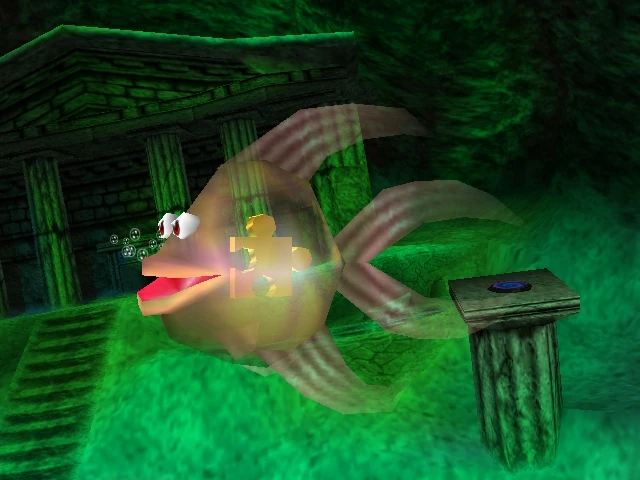
- Banjo-Tooie Is Pure Nightmare Fuel, And I Wouldn’t Have It Any Other Way | Nintendo Life
Alana Hagues goes to the mat for Rare’s oft-maligned mascot follow-up and its distinctly off vibes (Further Reading: Carmilla Morrell on Banjo-Tooie).
“Essentially, if Banjo-Kazooie is a cheeky little kid testing the boundaries, Banjo-Tooie is the messy teenager ready to prank and scare you around every corner. Sometimes, it’s pure nightmare fuel. But I wouldn’t change it for the world.”
Subscribe
Critical Distance is community-supported. Our readers support us from as little as one dollar a month. Would you consider joining them?
Contribute
Have you read, seen, heard or otherwise experienced something new that made you think about games differently? Send it in!