

Welcome back readers.
We’ve got nineteen new-and-cool selections for you this week. If this is your first visit, we have a Patreon that has helped us bring you a slice of online games crit each week for (counts on fingers, runs out of fingers). . . a lot. . . of years and counting. Please help us keep doing this for many years to come!
This Week in Videogame Blogging is a roundup highlighting the most important critical writing on games from the past seven days.
Platformer Studies
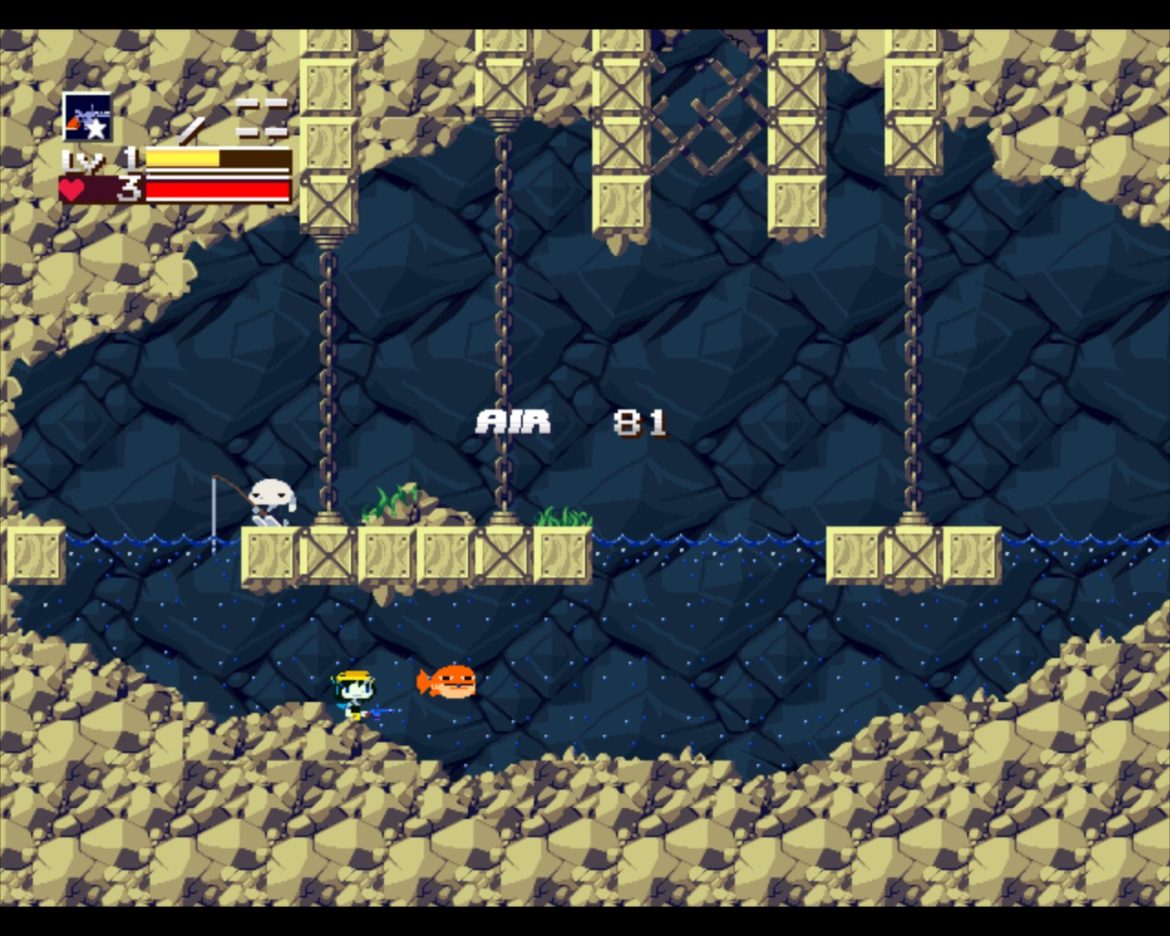
Our opening section this week locates two different platformer games from two different eras in their respective historical contexts, both within games as a medium and the wider world in which they are made and played. I can call Cave Story a platformer, right? Nobody’s going to @ me for that?
- Monty on the Run – “Bon Voyage Monsieur Le Monty” | Super Chart Island
Iain Mew details the unusual union-busting origins of one of the more notable platformers from the microcomputing era. - Cave Story Revisited | S Y S T E M / L A B Y R I N T H > N E X U S
phantom historically situates Cave Story as a keystone work for both the doujin and indie traditions (Further Reading: Jesper Juul on the long history of “indie”).
“Cave Story didn’t singlehandedly bring the modern indie forth. The indie scene is already full of inflated origin stories as it is, and what is so often presented as a unified culture with a single history is more like a series of semi-independent threads with their own individual origins (the earlier thread by Kayin touches on this elsewhere). In a way, what happened over the course of the ’00s is that the doujin, Flash/Newgrounds, and TIGSource threads gradually overlapped, and finally collided. By the time Indie Game: The Movie had come out, most of the groundwork had already been set. By the time Braid had come out, most of the groundwork had already been set.”
Text and Audience
These next four picks range widely in style and scope but all of them, in some way, are concerned with audiences–audience specificity, audience expectations, audiences across borders, audiences across eras.
- ‘Horny’ is not sufficient! | Hotel Paintings
Em Reed locates “horniness” as a kind of unsatisfactory waystation between overt prudishness and more fulsome explorations and depictions of sex in media as a complicated practice with narrative and character consequences (Further Reading: Grace Benfell on what it means for a game to be horny). - Everyone, please get to know the super great game: “Fantasy Maiden Wars”?JAKE
Jake hypes up a long-gestating Touhou SRPG in the hopes of it finding an international audience. - Mahou Shoujo no Majo Saiban and Death Game Mysteries as Spaces for Mental Health Discussions | Mimidoshima
Kastel plays a yuri death game that fuses the anti-authoritarian punk sensibilities of older works like Battle Royale with a more contemporary focus on teenage mental health. - The revolutionary politics of Final Fantasy Tactics, and why Ramza Beoulve is a hero for our times | Eurogamer
Harper Jay MacIntyre contemplates the political heretics–the Ramza Beoulves–of our time (Further Reading: Chuck Sebian-Lander’s FFT fansite).
“None of our current world, of course, was on Matsuno’s mind when he wrote this tale so many years ago, but it’s hard not to feel that Ramza is an even more resonant hero in 2025 than he was back in 1997. All you need to do, to see the “ease at which men are branded heretics”, is open your morning newspaper. Yet the revelation of this story now, from Arazlam to the player, holds hope: that in time history does recognise the “truth” of a matter. That even the small and perhaps invisible acts of goodness, which often seem overshadowed by the sheer power of status quo institutions, are sharp enough to eventually cut a path towards a better future. That while courthouses and churches and other institutions can last a long time, justice and truth will outlast them. All the more reason to stand for those principles, regardless of what they might call you.”
Distance Fog
We ought to talk about horror games in October, right? Fortunately, Silent Hill f has just come out, and even more fortunately, it seems to be quite good. Here are some reads on both f and the wider Silent Hill series.
- Nightmare Logic and the Horrors of Confusion | Unwinnable
Emma Kostopolus observes how dreams and Silent Hill alike eschew the causal rules of the waking world. - Silent Hill f revives the horror series’ 26-year-old debate: can combat be so bad it’s good? | GamesRadar
Francisco Dominguez situates Silent Hill f in the broader spectrum of the series wide-ranging takes on combat, from the purposefully clumsy to the prolifically competent (Further Reading: Ed Smith on the mechanical embodiment of SH2 remake’s player-oriented protagonist). - The Erotic and Grotesque Roots of Silent Hill f | Endless Mode
Madeline Blondeau unpacks Silent Hill f‘s portrait of institutional misogynistic violence in Japan past and present, and the ero guro art movement that rose in reaction to it (Further Reading: Astrid Anne Rose on the sanctification of sex, sickness, and suffering in the original SH2).
“If classical erotic grotesque work is a metaphorical representation of misogyny, then Silent Hill f is one of misogyny’s consequences. It is a question of what happens after a young girl is maimed a la one of Saeki’s subjects. Can a girl truly be destroyed, or does she simply change forms?”
Cyberpunk Pasts, Presents, Futurities
We found some great reads this week on cyberpunk and its structural critiques at different scales, focused on but not restricted to 2077.
- Veins Shooting from an Urban Sprawl: Cyberpunk 2077, Citizen Sleeper, and The Dream of Escape | Undermatrix Junction
Roxanne B thinks about the nostalgic past, urbanity, and cyberpunk futurity via 2077 and Citizen Sleeper. - Cyberpunk 2077 and the Anesthesia of #Dissent | Typebar Magazine
Sam Reader juxtaposes 2077‘s older punk sensibilities against a contemporary cyberpunk discourse that prioritizes more unambiguous answers to larger-scale questions (Further Reading: Phoenix Simms on Solace State).
“Cyberpunk 2077 isn’t a modern dystopia. It’s an older, unfairly overlooked form of dystopiana, one that asks questions that don’t have an easy answer or a tidy solution. Cyberpunk at its best is a morally complex genre where levels of ambiguity hold sway, where “good guys” are forced to make bad choices and aren’t always as good as they seem. It eschews the obvious for the cerebral in a way that is anathema to the normal modes of media publishing. That isn’t to say stories of resistance and deliverance don’t have their place, but that’s an entirely different toolbox and an entirely different set of tools than dystopian literature. More aspirational genres (fantasy, space opera, social SF, etc) are better suited to that.”
One Step at a Time
Here’s another single game section, with what I’m told is the easiest game to play yet that Bennett Foddy had a hand in.
- Baby Steps isn’t ‘Twitch slop’, you have simply let your sense of wonder atrophy | Rock Paper Shotgun
Nic Reuben steps away from spectacle and towards an experience (Further Reading: Lotus on “friendslop”). - Game Journal: Baby Steps | Kayinworks
Kayin meditates on the uphill battle of being at ease in your own shoes.
“I can’t tell you exactly what’s going on or what happened to Nate, but the narrative reality is less important than the thematic one. The game wants you to do something. Get out of your comfort zone and do anything, even if it is small and trivial. Even if it’s just taking baby steps.”
As Above, So Below
This next section is part-Trails, part-worldbuilding in its focus.
- La historia de Silksong explicada: Análisis a fondo del ‘lore’, los finales y misterios de Telalejana | GamerFocus
Julián Ramírez unearths the history of Pharloom and its relationship to faith, empire, and maternity. - Back to the Beginning – Trails in the Sky 1st Review (PS5) | Gamesline
Rose takes a point off because you can’t dress up Joshua. Also that localization (Further Reading: Marc Normandin on the Trails remake and literary editions). - The Cookbook Theory of Trails in the Sky | Unwinnable
Emily Price muses on the worldbuilding of cookbooks (and Trails).
“As is so often the case in real life, to make something in Trails, you have to have eaten it first, which means someone else has to cook it for you. The series’ commitment to this simple exchange is an example of its ethos as a whole: that the social connections that can be so throwaway in other games are central to the mood, the vibe, in other words, the thing that makes it work.”
Skong but Not Forgotten
I most certaintly did not put these next two articles in a section together solely because they both have the word “love” in their titles. I would never do that.
- Our Love-Hate Relationship with Silksong’s Compass | Endless Mode
Maddy Myers gets lost in Silksong–but not in the good way. - Fragments of Love | Inner Spiral
Alli comes back to Moon Remix RPG Adventure, to the town where love finds a way, is the only way (Further Reading: Vidyasaur excavates an early and unusual demo for Moon).
“And once you’ve lived in that system long enough, it sneaks into your bones. You start noticing how easy it is to treat love like a given, like it should just appear, when in reality it’s the hardest kind of work, it’s invisible to almost everyone else, and that only matters if you’re willing to give yourself to it. Moon makes you rehearse that truth over and over, disguised as a joke about patching up cartoon animals, until suddenly you realize you’ve been practicing the hardest part of being alive: making love real by choosing to keep doing the work.”
Critical Chaser
: )
- Polybius [198X] | Arcade Idea
Ara Maybury hunts the Wumpus.
“Despite being an exceptional piece of cargo, it actually came down at the last minute through the usual channels, the ones the nose candy went up. I didn’t need anyone to tell me how to put this jigsaw together. The G-Men were the ones putting dope in California’s veins, that was the only part of Iran-Contra anyone even still managed to deny. This quarter-ante scheme went all the way to the top. At around midnight on November 12th, he loaded the cabinet back up in the van from whence it came. From there it was ferried to one of the routine stoplight shakedowns — except this time, instead of just finding some television sets that had fallen off the back of a truck, they were loading an arcade cabinet into one. He thinks it was bound for Nevada, on account of its plates. The next morning, they had to draw the curtains on the poor sap. Old age, the obit read. That was the official story.”
Subscribe
Critical Distance is community-supported. Our readers support us from as little as one dollar a month. Would you consider joining them?
Contribute
Have you read, seen, heard or otherwise experienced something new that made you think about games differently? Send it in!