

Welcome back readers.
Thanks for your patience when it takes me some extra time to get these longer editions out. Did I plug the Patreon yet? Ah, there we go. That’s the best way to keep our project documenting and organizing critical conversations on games going strong. Thanks as always for sticking with us!
This Week in Videogame Blogging is a roundup highlighting the most important critical writing on games from the past seven days.
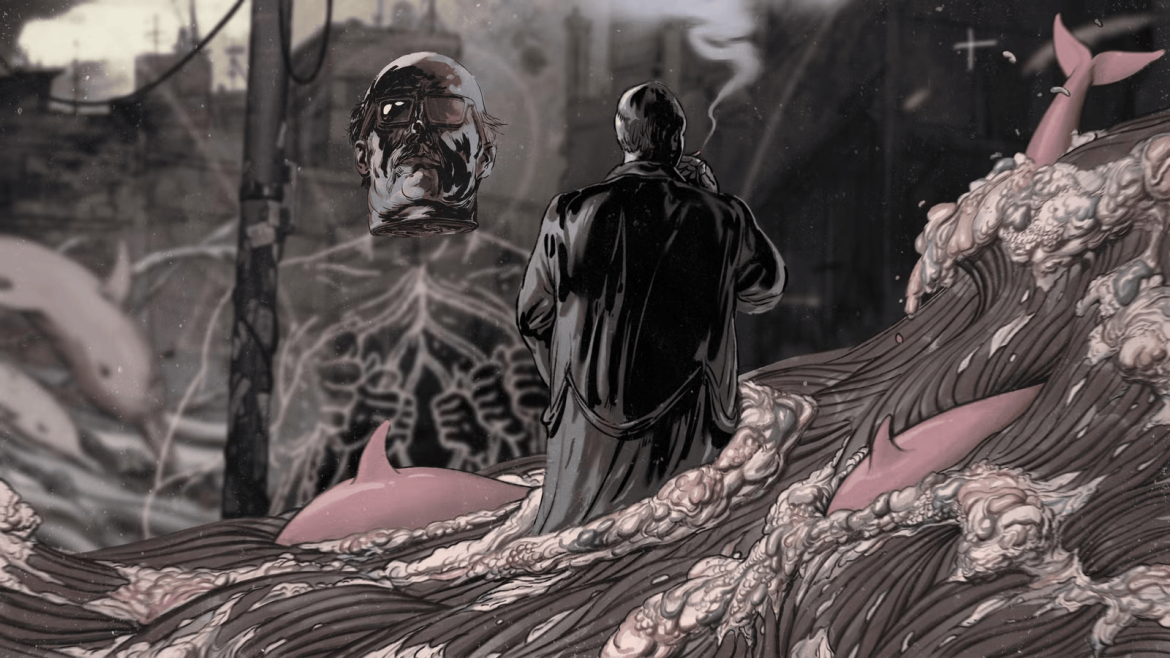
Zero Parades
Three up top for the new RPG this week.
- Review: Zero Parades (For Dead Spies) | No Escape
Kaile Hultner traces social topography at the end and beginning of history (Further Reading: Ruth Cassidy on Cops and Community in Disco Elysium). - Zero Parades and a Bleak Espionage Triumph | Remap
Dia Lacina cascades into the wondrous, ruinous orbit of Hershel Wilk. - Zero Parades: For Dead Spies review – it’s the RPG we don’t deserve | Eurogamer
Alexis Ong maps out the politics of desire in a Portofiran Bazaar (Further Reading: Emily Price on Stuff in Revachol).
“There is a razor-sharp throughline of plastic and bootlegging in Zero Parades, written by people who understand, on a cellular level, how a bootleg Goku alarm clock unearthed at an estate sale can be quintessentially Mexican and Arab at the same time, and what that means not just for ‘culture at large’, but for how desire shapes a people and a place and a soul. Portofiro is brimming with postcolonial conflict, as media and fashion continue to bleed in from the Illuminated Empire. It’s not a clean analogy to simply say that La Luz is America, but the dynamic here is recognisable to anyone who has spent meaningful, self-aware time outside the borders of empire.”
Vana’diel Life
One of the considerations in the previous section concerns the geography–physical, sociological–of Portofiro. Let’s keep that focus on spaces as we look to other games.
- An Ode to Vana’diel and the Texture of Digital Worlds | Astral City Mini
Derek Heemsbergen finds that FFXI‘s topographical richness does not survive conversion into an FFXIV event (Further Reading: Dia Lacina on Final Fantasy XI). - Paper Towns and Potemkin Villages | Unwinnable
Jonathan Fenn traces the tension between the player protagonist and the uncanny village.
“The verisimilitude of videogame towns and the NPCs within them can definitely be improved, but they should still ultimately serve the narrative thrust of the game. So how should developers and writers face the challenge of how to make players care about a world in which they can never truly be a part?”
Sex Positive
Adult Analysis Anthology returns to head up a section on, well, adult games!
- Either Way, What Bliss: The Problem Of Balancing A Game For Players Who Want To Fail | Adult Analysis Anthology
Kangoo digs into the particular design challenges of failure amplified in adult games (Further Reading: Morgan K. on the seduction of the Game Over). - In Love And Deepspace, Intimacy Is The Ultimate Gooner Bait | Kotaku
Ash Parrish has high praise for a sex-positive gacha game doing things a bit differently.
“There wasn’t any act being depicted in Love and Deepspace’s sex scenes that was too graphic for me. But what I was unprepared for was a simulation of intimacy—the eye contact, the POV changes, whispered endearments, gentle touches—so thorough that I felt exposed just by participating in it. Essentially, what shook me to my core about Love and Deepspace is that it’s the first time a porn game made me feel the mortifying ordeal of being known—biblically or otherwise.”
Talking It Out
Three interviews this week on a wide spread of games and topics.
- Kumitantei: Old-School Slaughter Loves Danganronpa And Isn’t Ashamed To Say It | startmenu
Hiero de Lima talks to Mango Factory director Selina Kibara about Kumitantei, the indie mystery game scene, and charting their own path from Danganronpa. - “GTA for 8-Year-Olds”: A 20-Year Retrospective on Barnyard | This Week in Videogames
Maddie Agne chats with Nick Hagger about how Otis got his squirt on. - In Palestine, One Game Developer Wants To Share A Dream Of His Land’s Beautiful Past | Kotaku
Rebekah Valentine talks to Rasheed Abueideh about the challenges of developing Dreams on a Pillow under the shadow of Israeli occupation (Further Reading: Amaar Chowdhury’s interview with the developers of Palestine Skating Game).
“When you imagine Palestine, what does it look like in your mind? Does it look like the photographs we see in the news all the time? Do you see abandoned buildings and piles of rubble? Rocky, barren land? Exhausted individuals standing in long lines for humanitarian aid? The injured, the sick? The dead? Or could you imagine a different Palestine, one with lush gardens and flowering trees? Could there be colorful handmade crafts? Plates of delicious food? Clear rushing water? What about community; what about neighborhoods and towns where people gather cheerfully for meals, celebrations, or just because?”
Castle Oblivion
Old RPGs underpin our next section.
- In the Cards – Kingdom Hearts Re:Chain of Memories | Pixpen
Sam Howitt circles back on Kingdom Hearts‘ brief deckbuilding era and contemplates shifts in character perspective and medium of expression. - Shin Megami Tensei: A Mega RPG | Kimimi The Game-Eating She-Monster
Kimimi plays what just might be the finest port of a landmark RPG. - Strategy and Predetermination with the Bangaa in Ivalice | Unwinnable
Alyssa Wejebe ponders Final Fantasy Tactics Advance, racial tropes, and bioessentialism in fantasy stories (Further Reading: Jeffrey Rousseau on Metaphor and fantasy racism).
“There could’ve been more creative nuance made more explicit, instead of only gameplay challenging the text a little. Just a few words could’ve presented the idea that the bangaa’s large size and strength didn’t automatically make them rough and bellicose, or prone to quarreling; it didn’t have to automatically make them warriors. A few words could’ve given some indication that perhaps they usually had a warrior culture to go along with their strength. Perhaps a few words could’ve even left the idea that a world treating them with suspicion and fear for their size and strength made them rougher around the edges. Perhaps the world of Ivalice only ever wanted the bangaa to fight on the frontlines.”
Processing Units
Next up: how games tell stories of trauma and grief. You know, light stuff.
- The House of Hikmah: Swimming in Grief, Without Drowning | Gamers with Glasses
Wallace Truesdale takes the rare occasion of a game localized in Arabic to contemplate how stories communicate the language of grief. - Facing a Bitter Mirror in Undusted: Letters from the Past | Gamesline
Franny cleans keepsakes and meditates on unresolvable family traumas (Further Reading: Luca Fisher on 1000xRESIST).
“It’s a very personal story, and the depth and detail remind me yet again how a certain experience can be elevated by the player rather than the reader or watcher. Cleaning, thinking, coming to terms with each step of the story. Taking the time in its fullness, along for the ride with the author. Part of my bitterness is seeing a familial relationship that could be mended so easily in comparison to my own, but Adora’s story is familiar in its inevitability – there is no ending reflective of an entire life, all the rights and wrongs, things said and unsaid, perfectly preserved in a final moment of satisfaction. Mend what you can, brace for what you can’t.”
Artfully Done
Inquiries into art as product, as production.
- We Might Have To Get A Little Less Fandom-y | Curmudgeon Dot Com
Mo Drammeh examines the cultural and capital forces that skew our interpretative reationships wth art (Further Reading: Alli on fandoms and purity culture). - Can we stop blindly accusing indie games of using generative AI? | Luna’s Gaming Log
Luna cautions against throwing AI accuastions at indie games without due diligence. - notes dump 2026 | harmony corpsepit
Stephen ponders desire, risk, and the bifurcation of art: profession or hobby, official or unofficial economy, work or dream (Further Reading: Stephen’s previous writing on the itch.io ban).
“a thing i keep coming back to with money is: the gulf between the quantitative and the non-quantitive. people in the early artgame era used to earnestly wonder how much a tiny yet moving game was worth, how much a sunrise might be “worth”. but even the lowest forms of quantity (the dreaded 100 hours of gameplay) have an absolute advantage over the totally non-quantitative, which are famously the things money can’t buy. shall we introduce still more vague proxies for the “worth” of art, meaning etc, and then watch once again as those proxies cover and suffocate the thing they’re meant to be about? it seems to me the only way to get away from this is to move away from the idea of exchange and into that of sacrifice: the willed destruction of money by dumping it arbitrarily back into the black hole that is the mass existence of other people, with as little distinction or qualification as possible. an acceptance of the place of the non-quantiative, the thing nobody can predict. accept no arts budget that has no line item for self annihilation.”
It’s Not a Sprint
Sometimes my capacity to string articles together by theme eludes me. What do these next two have in common? Well, they’re both about recent games, and, um… they’re both very good.
- sorry i don’t love you | Plant or Beast
Ashley Bardhan plays Resident Evil Requiem and dwells on empathy as it is shaped by gender socialization (Further Reading: Skeleton on zombie women in Resident Evil). - why gun games, after all this time [or] player vs. player vs. environment | Bullet Points Monthly
Pao Yumol ruminates on zone fiction, the New Weird, and becoming a Gun Girl (Further Reading: Grace Benfell on Marathon).
“we wander through tau ceti and turn its wreckage into urbex playgrounds. we find the routes that seem less frequently trafficked and begin to build memories atop them. we get to know one another under the cover of a smoke grenade, through bleak morse codes of gunfire and footsteps. the further we wander into marathon, the more distant i feel from the part of the world that cannot understand me. only rabbit would really get what i mean when i try to make the clumsy case that miranda july’s the first bad man is both toxic yuri and zone fiction.”
Critical Chaser
Beginning and ending the week with Zero Parades. Kind of.
- Zero Parades: For Unwanted Art | Patreon
Ela Bambust will not give the discourse any satisfaction.
“PATREON ESSAY — There’s opinions about the game out there. It’s good. It’s bad. It’s neither. It’s both. You won’t find them here.”
Subscribe
Critical Distance is community-supported. Our readers support us from as little as one dollar a month. Would you consider joining them?
Contribute
Have you read, seen, heard or otherwise experienced something new that made you think about games differently? Send it in!