

Welcome back readers.
We’ve got tons of reading to share this week–22 articles to put a number on it–and that includes a lot of writers making their TWIVGB debut! Don’t forget to check out our Patreon if you like what we do here and want to help us keep doing it for many years to come!
This Week in Videogame Blogging is a roundup highlighting the most important critical writing on games from the past seven days.
Pride of Place
It may be July, but Pride is a year-round thing at CD. Here’s four seasonal, all-season picks up top.
- How Samurai Shodown Turned a Catholic Radical Into a Gay Warlock | Thrilling Tales of Old Video Games
Drew Mackie charts the long and winding pop-cultural history of the transcultural, trans-species, and occasionally transgender Akamusa. - A long-buried secret hidden in a cosy game about books made me realise something essential | Eurogamer
Lottie Lynn finds a bit of sapphic sanctuary and mystery in Tiny Bookshop. - The surprising queerness of Elden Ring | Eurogamer
Kelsey Raynor charts themes of gender ambiguity and transness across the Lands Between (Further Reading: Samantha Greer on Elden Ring‘s thematic queerness). - How games can “queer the concept of time” – and help us explore, interrogate, and reinvent our relationship with life’s many milestones | Eurogamer
Khee Hoon Chan surveys a variety of expressions and abstractions of queer temporality across games (Further Reading: Kara Stone on queer temporality and reparative game design).
“It’s perhaps notable these games are tinged with an apocalyptic element where time is becoming a scarce resource, and their protagonists must reckon with their ephemeral circumstances. The concept of queer temporality emerged, after all, with the onset of the AIDS epidemic in the 1980s, when the contours of time were reshaped for many in the queer community; 324,029 men and women died of AIDS-related illnesses between 1987 and 1998 in the USA alone. Queer time is thus foregrounded as a liberatory expression in games, one that can help queer individuals like myself explore, interrogate, and reinvent our very relationship with – and against – the passing of time, and of life’s myriad milestones.”
So Long, My Love
These next two sections constitute a very loose continuum between design and aesthetics. Let’s start with the ones I thought were a little more design-minded.
- Reality, Realism, The Hyrule Fantasy | Lakespirit
Lakespirit assesses the original Zelda‘s heady cocktail of freedom, constraint, and realistic, not realist design (Further Reading: Ara Maybury on The Legend of Zelda). - The Tactics of Social Simulators | Medium
WordsMaybe traces the ongoing influence of tentpole VNs of the 90s on RPGs and strategy games today (Further Reading: Kastel on how to talk about visual novels). - “Get me into the game”: Kimmo Lahtinen on Sektori | Gamers with Glasses
Don Everhart chats about the design and artistry of twin-stick shooter Sektori with its principal designer. - Before the Future Disappeared | Cat Calls Soup
Akshit Dangi catches glimpses of a PS2-era game design futurism in the opening chapter of Metal Gear Solid 2 (Further Reading: Kimimi on MGS2).
“What’s remarkable is how unnecessary almost all of it is. Snake could go through his mission in a perfectly static cargo ship, and the main chunks would still work the same way. Noticing the rain, shooting the bottles, admiring the shot glass aren’t mandatory, but the game almost wants me to notice it all. It seems less interested in taking down a Metal Gear than in inviting me to poke at everything around me. It wants me to stop and appreciate that someone, somewhere, thought about how an ice bucket should sound when shot across a table.”
The Humanoid Must Not Escape
And now for the more aesthetics-oriented group.
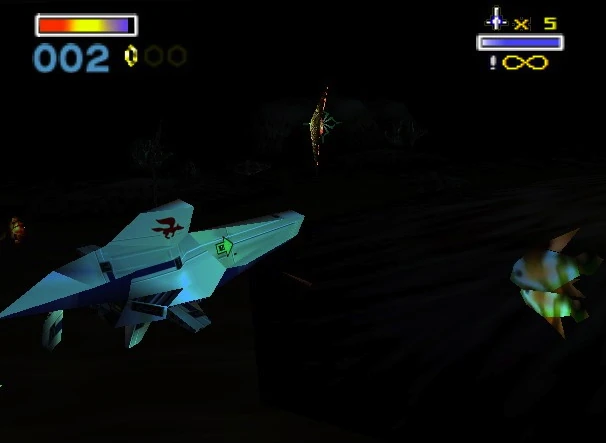
- Star Fox 64: Let’s rock and roll! | Kimimi The Game-Eating She-Monster
Kimimi evaluates artistry, perspective, and routing in the age of the Reality Coprocessor. - you broke me: an emotional Doom experience | You Found a Secret Area!
beverly jane checks out a DOOM mod making the rounds with emotional and technical range in equal measure (Further Reading: J.M. Henson on myhouse.wad). - The Beauty of Berserk | moth place
Lilly revels in the Atari 2600 game’s disquieting aesthetic minimalism (Further Reading: Crystal on Dragonstomper).
“It’s amazing what little design elements can do for enriching an almost featureless world. This smiley face, as it turns out, is a hint at something sinister lurking within. For now, I must simply keep shooting.”
Crimson Butterfly
A pair of critical examinations of femininity in play.
- A Doll’s Eyes, A Woman’s Hands | TIER
Grace Benfell threads together gender, labour, and the relationships and agencies that frame both in in Forget-Me-Not (Further Reading: Phoenix Simms on Forget-Me-Not). - She’s wearing my clothes | plant or beast
Ashley Bardhan muses on clothes-as-kinship between the women of survival horror (Further Reading: Ashley’s previous writing on the Death Dress).
“the more I play Fatal Frame 2 and Silent Hill f, the more I want to join Mio and Hinako in wearing their shared gold shimmer top, tiered angel cake skirt, and simple berry ballet flats with a butterfly-shaped bow. I know they’re both in Hell, but if we attended in uniform, it might not be as scary. We could share our cutest clothes, let them touch our wings and brush off the scales, then lazily accept our pretty death like butterflies.”
Vantage Points
Meditations on games, culture, and the worlds that produce both.
- hold right by myself | gAmeDHD
Sam Vu Nguyen learns to look beyond the grindset mentality, in Cairn and in life (Further Reading: Steven Santana on Cairn). - Mark Phillips Is My Favorite Mario | Exalclaw
Wallace Truesdale profiles an online comedy troupe with its finger on the pulse of Black gaming culture. - Repairing Historical Memory in Koyamachou | Gamers with Glasses
Dídac Jiménez Torras tends to trinkets, to memories, to lives in a small jam game about a watch repair shop (Further Reading: Franny on Undusted: Letters from the Past). - Big & Small | Medium
Abram Buehner dwells on scale and intimacy in Xenoblade Chronicles.
“Some thirty hours after I started Xenoblade, watching its credits, I understood why I could love the game now. It found me at a time when I feel small in a world that feels very big. I moved to Chicago, living in a city for the first time in my life. This isn’t Maine or Connecticut or Massachusetts or the suburbs of Nebraska. Here, I leave my apartment and get on the bus with other riders I smile at and a bus driver I thank, who takes me to places with buildings that loom over me. That I see along the horizon, a Mechonis of my own.”
For Queen and Country
James Bond and TTRPGs are linked together here with an examination of the erotic.
- Happy Eater | Bullet Points Monthly
Ed Smith notes the excision from First Light of everything that defines James Bond: the violent, erotic pressure valve for the waning years of a colonial empire (Further Reading: Willa Rowe on First Light). - I Only Want To Fuck The Dice | Adult Analysis Anthology
Darling Demon Eclipse articulates the appeal of–and vital need for–erotic tabletop games, payment processors be damned (Further Reading: Linda Codega on horny TTRPGs).
“I believe that erotic TTRPGs will persevere in some form, and I’ll keep playing them, to the detriment of my enjoyment of non-erotic TTRPGs, even! There’s no other medium and genre that thrills me, stimulates me and arouses me as much, and I hope to be involved in this sort of work for the rest of my life.”
Tabula Rasa
Our next two picks highlight the experience and influence of language.
- Beyond the ‘Whatevers,’ or “How Playing Final Fantasy VIII in Japanese Changed My Perception of the Game | Rachalog
Aly contemplates the characters–and characterizations–of FFVIII across languages (Further Reading: Phil Salvador on why Final Fantasy VIII is the best). - Mii, Myself, I and Thou | Unwinnable
Vehe Mently ponders the ontology, the cosmology, the phraseology of a Tomodachi life (Further Reading: Rae Maybee on the hauntology of the original Tomodachi Life).
“your friendships are rooted in little language games, and whoever helps you when you trip and fall over. hellohowareyounicetomeetyou. what do you think of this gerund? do you want this noun that that Something picked for you? that’s all there is to it, really. the town grows but the roots of your relationships do not, not really. “I and It” you say of Thou and They. Interiority? what Interiority? everyone you meet is hollow. but you’re not objectifying them; both of you were objects the moment you were born. baubles bumping in the bath. this is Love.”
Critical Chaser
Yeah the arcade at my local bowling alley sucks.
- Bring Back BattleTech | Seer talks about games
Seer implores arcade-goers and operators to get back in the fucking robot.
“Well, the market is stupid and the people in charge of arcades are cowards. Frankly, there’s a wide open path to re-invigorating that market that they’re not taking, and it’s pretty simple: just focus on delivering experiences you can’t get at home or anywhere else. Or, in other words, bring back BattleTech.”
Subscribe
Critical Distance is community-supported. Our readers support us from as little as one dollar a month. Would you consider joining them?
Contribute
Have you read, seen, heard or otherwise experienced something new that made you think about games differently? Send it in!